Monday, February 13, 2012

The Dark Side of South Africa

Why South Africa is like 1950s US
1. Racism is blatantly and shamelessly expressed. 
South Africans often pride themselves on living in the ‘Rainbow Nation’ because SA is more diverse than many other African nations.  However, ‘rainbow’ gives a false impression that everyone has been living happily and peacefully after apartheid; in reality, there is still significant fear and ignorance about people of other races or religions.  Even in the post-apartheid era, some people feel justified in their racism and express it freely.  Sometimes they will preface their comments as “I’m not being racist or judgmental,” which is invariably followed by a racist or judgmental statement.  In Durban, people still self-segregate so interracial relationships—marriages, dating relationships, even platonic same-sex friendships – are extremely rare.  People of mixed black and white descent (‘coloured’) are at the bottom of the totem pole in Durban.  They are considered the people who commit crimes and abuse drugs and alcohol.  Since Akbar is well-liked and respected here, when Indians are being racist, I bring up that Akbar is actually biracial to challenge their preconceptions about how much one’s race actually reflects one’s character.

Alien, a single South African mother, raising a multi-racial family.
2. Across all races, gender roles are male-centered and male-dominated. 
During apartheid, women were traditionally held as inferior to men; these ideas stemmed from traditional African beliefs as well as misreading of the Bible.  A recent church bulletin (in a mostly Indian church) stated, “Feminism is dead wrong!”  Even though many women in SA work full-time and more are getting university educations, it is still commonly women’s responsibility to do all of the domestic work.  If both spouses work, the women still act as primary caretakers of the children, and do all of the cooking and cleaning while husbands sit at the table and wait to be served.  People are shocked when we tell them that our fathers can cook for themselves, and well.  They are even more shocked to learn that Akbar’s father lives on his own and does not need a ‘helper’ (i.e. maid), to cook and clean for him.  ‘How can a man ever survive without a woman?’ is their unspoken question.
(http://en.wikipedia.org/wiki/Women_in_South_Africa)

Tai Long, 1 month old, growing up on the rough streets.
 3. Homophobia is rampant and often leads to violent crimes. 
Desmond Tutu, the former Anglican Archbishop of Cape Town and Nobel Peace Price winner, has said that homophobia is "every bit [as] unjust" as apartheid.  Since SA’s post-apartheid constitution outlawed discrimination on the basis of sexual orientation and legalized same sex marriage, the only African country to do so, SA has advertised itself to homosexual tourists as a “gay-friendly” nation.  Nevertheless, hate crimes are common and human rights organizations have criticized how the SA police and government handle these crimes.  Gay women in particular are frequently victims of beatings, rape, and murder.  In some cases, male perpetrators claim that rape will “cure” the woman of her sexual orientation.  In a country where most people come from a faith background, they somehow have forgotten that God loves everyone and calls us to love our neighbors as ourselves.
(http://www.afrol.com/articles/13584 & http://en.wikipedia.org/wiki/LGBT_rights_in_South_Africa

 4. The ‘meat and potatoes’ diet is alive and well. 
Despite decades of research proving that a high fat, high carbohydrate diet and large portions lead to heart disease, diabetes, and premature death, people of all races here continue to indulge in generous portions of white bread, potatoes, sodas, red meat, and sugary desserts.  To justify their ‘carpe diem’ attitude, they blame poor genes as the cause of their central obesity, clogged arteries, and early-onset diabetes.  As an American, I did not think I could be impressed by another country’s obesity or ridiculous eating habits; South Africa has proved me wrong.  South Africans die of heart disease and uncontrolled diabetes as early as their 30’s – especially those of Indian descent.  It is actually quite unique and sad for a country to be plagued by both developing world illnesses, such as malnutrition, HIV and TB, and developed world illnesses, such as diabetes, heart attacks and strokes.
Pumpkin, 1 month old, hiding from the smoke and pollution.
5. Smoking is common and accepted. 
Many people smoke on a daily basis as if the link between smoking and cancer has not yet been discovered.  We frequently find ourselves sitting and chatting in a group, even with doctors, where we are the only non-smokers.  Unlike the US, there is no shame in smoking around non-smokers, whether they are babies, patients, or pregnant women.  (Or sometimes the pregnant woman is also the smoker.)  Although smoking is not permitted in restaurants or hospitals, the rule is not enforced.  Nevertheless, restrictions on smoking areas and advertising, have decreased overall smoking.  In 2000, 43.8% of men in SA smoked, down from 51.4% in 1993.  Progress is further evident in the 40% decline in cigarette consumption between 1990 and 1999.  SA has made smoking its 2nd health priority after HIV.  One man we met always complains that his wife and children are such horrible asthmatics, needing to carry their inhalers all the time, yet he smokes over a pack a day and refuses to recognize that he may be exacerbating their symptoms.  Another man who was recently diagnosed with TB, for the 2nd time, reports that smoking helps his chest feel less tight.  I often wonder what health consequences we may have after a year of regularly inhaling second hand smoke (and the sulfurous gases from the oil refinery half a mile down the road).
(http://archive.idrc.ca/ritc/sarelease3.pdf & http://www.cansa.org)


Obviously, these problems exist in other countries as well as SA.  However, they are pervasive here to a degree that, despite its relative wealth and political stability, the country’s development is adversely affected by them.  On paper, SA’s goals are that of a progressive, forward thinking 21st century nation that has far outpaced its African neighbors.  The attitudes of average citizens, the daily lives of those struggling in poverty, and the health outcomes and social indicators data tell a different story.
Samson, a fatherless South African child found on our doorstep.
South African Fact:  There is a national campaign to circumcise males between 15 to 49 years old in an effort to decrease the transmission rate of HIV.  Our hospital has an entire ward dedicated to adult circumcision and, surprisingly, men line up there daily, waiting to be circumcised.  The new interns are expected to perform 100 circumcisions each before the end of their 2 year internship. (I suggested that we give vasectomies at the same time; far too many fatherless children are raised in poverty by their grandmothers, or are abandoned to the streets.)
Circumcision campaign poster in hospital hallway.

Friday, February 3, 2012

Experiencing South Africa

Fraud, Part of Everyday Life
Most people know that crime, like theft, muggings, murder, and rape, is a part of daily life in SA.  What we did not know was that fraud is also very prevalent here. A SA newspaper claims that 15-18% of professionals here have fraudulent certifications.

In December, a doctor from the Congo was discovered to be falsely registered to work as a neurosurgeon in SA.  He had worked at 2 private hospitals and opened a private practice before his credentials were finally questioned due to incompetence.   He was already banned from practicing in Botswana and Zimbabwe.  This man did not have any residency training and he was pretending to be a brain surgeon!  Last year 6 Nigerians were found to be fraudulently practicing as physicians as well.  The same Health Professionals Council of SA (HPCSA) that has allowed all these fraudulent people from developing countries to work as doctors is the same organization that has given us so much trouble and not registered us when we are fully trained doctors from a 1st world country.

Most recently, the HPCSA has questioned the authenticity of our documents, including our passport.  It is a huge blow to your ego when someone questions everything from your identity to your education that has taken your entire life to accrue.  We have had to explain every document to them because they are obsessed with minutia - everything from the type of hospital stamp to the way our documents are notarized.  For example: our initial hospital documents had an embossed stamp, which was inadequate.  Then we had the documents re-couriered over with an ink stamp and gold seal, which apparently is still unacceptable. Nevertheless, they have agreed to register us to work if we get our documents notarized the South African way.  We hope and pray that this is all they need.  We appreciate all those who have been emailing, praying, and being supportive from afar. 

Zulus
Durban is located in the province of KwaZulu-Natal (KZN), which is home to the Zulus, one of the ethnic groups in SA.  Although the Zulu monarch does not have any official political power, he lives in KZN and receives a stipend from the government, similar to the royal family in the UK.
Zulu Drummers
Languages with Clicks
Most South Africans are multilingual. There are 11 official languages here and several of them have clicks.  Although English is the language of politics, economy, and the media, it only ranks 5th out of languages spoken at home (only 8.2% of people).

The accent of the Indian South Africans has been the easiest for us to understand because English is the primary and only language spoken by most Indians.  We have probably had the most difficulty understanding the white Afrikaners’ accent.  Afrikaans has its roots in 17th century Dutch.

In 2001, isiZulu was spoken by 23.8% of the population, making it the most common language spoken in the country; in the province where we live, KZN,  80.9% of the people speak it.  It is followed by isiXhosa at 17.6% and Afrikaans at 13.3%.
Zulu Dancers
The clicks come from the Khoi-San people who live predominantly in southern Africa.  Most people know them as ‘Bushmen,’ popularized by the 1980s movie, ‘The Gods Must Be Crazy.’ 15% of words in isiZulu and isiXhosa contain clicks.  The types of clicks are numerous and subtle.  Like tonal languages (such as Mandarin or Vietnamese), the differences are difficult for a non-native speaker to appreciate.  In Zulu, they are variously described as ‘a dental click’ (written as a ‘c,’ pronounced as a ‘tsk, tsk’ with the teeth), a ‘palatal click’ (written as a ‘q,’ pronounced like ‘a cork popping from a wine bottle’), a ‘lateral click’ (written as an ‘x,’ pronounced as ‘the clopping of horse hooves), etc.  IsiXhosa has even more variations.  Even the name of the people and their language, ‘Xhosa,’ starts with a click (try saying that out loud). 

As you can imagine, we have great difficulty making these sounds - without being laughed at or feeling like we are going to choke.  One of our construction workers goes by ‘Patrick’ in the city, but his Xhosa name is ‘Xatiana’; despite numerous attempts, we could not pronounce it correctly. Though these clicks are often ridiculed in the US, they are taken for granted by non-black South Africans; some Indians and whites can even manage them quite well.

Zulu Dancers

Zulu Basics
 
Sawubona                    Hello (one person).
Sanibonani                    Hello (many people).
Yebo                            Yes
Cha                              No


Story about Words
I was asking one our friends what South Africans called these small, green chiles I had.  She quickly said “joll-i-peen-nos.” I did not catch it initially because it was a multi-syllabic new word.  I asked again, and she said “joll-i-peen-no.” Then I saw Akbar smile and I realized it was her way of saying the Spanish word “jalapeƱo.”  There are no Spanish influences here, so of course the pronunciation would be different.

South African English Word                              American English Word
Robot                                                               Traffic Light
Boom                                                               Gate
Brinjal                                                              Eggplant
Boot                                                                 Car trunk
Bakkie (pronounced ‘buckey’)                         Pick-up truck
Theatre                                                            Operating room
Gynee                                                              Gynecologist
Packet                                                              Plastic grocery bag                              
Braai                                                                BBQ                                                   
Dagga                                                              Marijuana
SMS                                                                Text message
Serviette                                                           Napkin

South African Fact:
During apartheid, each race was assigned to a different neighborhood and beach.  Only the beaches for the whites had shark nets. 

Data from the University of Florida shows that there were 31 shark attacks from 1905 to 1990 between Cape Town and Port St Johns.  Although attacks have risen to 94 incidences from 1991 to 2010 due to human factors, SA still has fewer attacks than the US. 


Thursday, January 5, 2012

A Happy New Year

A Happy New Year
We spent New Year’s Eve having dinner with church friends and then attending a church service.  Going to church on New Year’s Eve was a first for both of us.  Apparently evening service on New Year’s Eve is common here and the church was packed full of families dressed in their Sunday best. We did not get to bed till 2 am, and then we were back again at 9 am for the regular Sunday morning service.  Not a bad way to start the New Year.

Our New Babies
Our cat Alien rang in the New Year by giving birth on January 2, 2012.  Mom and her 2 babies are healthy and doing well.   She has decided to solely breast feed because it is better for the physical and mental health of her babies.  I had prayed that she would have less than 3 kittens because life here is difficult for animals (and people), and it would be challenging for us to care for and find homes for a litter of 4 or 5 kittens.  God definitely answered my prayers; I didn’t know that cats could even have 2 kittens. 
1. Ginger & White Kitty
2. Black & White Kitty
What do we have in common with the Dalai Lama?
We are both victims of South African bureaucracy.  The local paper, The Mercury, ran a story on December 28th announcing that the Dalai Lama would be receiving the Mahatma Gandhi International Award for Peace and Reconciliation on January 6th in India – because he was not allowed in to South Africa (SA).  Originally the award ceremony was planned for October in SA.  (The Dalai Lama was also supposed to attend Desmond Tutu’s 80th birthday that same visit.)  However, he could not enter the country because the government never processed his visa application.  After reading that article, I could not help but laugh.   It is both comical and tragic.  It highlights the inefficiency and lack of transparency of SA’s bureaucracy.  If the Dalai Lama, an internationally recognized political/religious figure whom SA invited to attend events in the country could not get his visa application approved, it is not surprising that 2 unknown doctors from the States are struggling to get their medical registration processed.  (You will all be happy to know, though, that the government has assembled a commission to investigate ‘the Dalai Lama incident’ – probably full of the same people who were responsible!)

How have you been spending your time?
Since we do not have a television, car, or reliable internet, the Americans out there probably think we are bored out of our minds or are going stir-crazy.  In actuality, we have been quite busy and entertained, in part because our friends regularly take us out and in part because we have chosen to take advantage of this “down” time.  Akbar and I were looking back and neither of us has had this much free time since we were 5 years old.  That is not to say that this waiting game is not stressful (it is—especially for 2 control freak physicians), but we are trying to be patient and make the most of this God-given time.
Alien and her babies (Day 2 of life)

We spend most of our days reading, caring for the local cat population, cleaning, and cooking. Fortunately, although we are around each other most of our waking hours, we are still enjoying our time together and having fun.  It may be delirium setting in from being “trapped” in a dangerous foreign country with no car, but we laugh together daily.  On Tuesday nights we accompany our friends to Bible study; on Sunday, church evolves into an all day event: first services, then lunch at our friends’ house followed by tea time, then a leisurely afternoon drive to the beach for Indian snacks or a shopping trip.  Another friend of ours from the hospital visits us almost daily on his lunch breaks, and hangs out with us on his post-call days; we’ve enjoyed numerous outings with him and his fiancĆ©e to the movies, the mall, and numerous restaurants around Durban.

Accomplishments the last 2 months: completing several books (medical, fictional, spiritual, and otherwise), deepening our relationship (with the help of a pre-marital counseling book and its probing questions), and watching all 3 Godfather movies for the first time (something we have wanted to do for years).  One book in particular stands out, in that we both enjoyed it immensely: Cutting for Stone by Abraham Verghese.  We both read all 600+ pages in just a few days.   It is a story about family, friends, Ethiopian political upheaval, and immigration, set in a medical back-drop.  We highly recommend it.  (When all else fails, we also try to keep up our medical education: journal-reading, books about South African medicine, HIV/TB, and hospital medicine.) 

Watching the ‘Godfather’ trilogy here was an interesting experience.  In a country where the crime seems random, violent, and haphazard, the glamour Hollywood casts over organized crime in America provides a stark contrast.  People tell us though, that there is organized crime here, with involvement in the international drug trade, car-jacking rings, and high profile thefts (once, an entire ATM machine was pulled out of the wall with a tow truck and driven away).  A favorite scapegoat here is ‘the Nigerian mafia.’ 

South African Fact:
SA’s population is 49 million as of July 2011.  Although SA is a relatively wealthy and resource-filled 2nd world country, many of its national indicators are even worse than 3rd world countries.  According to WHO statistics in 2006, life expectancy in SA is 48 years, worse than countries like Somalia (50 years) and Ethiopia (56.2 years).  Other 2nd world countries like China and Brazil have life expectancies > 70 years old (CIA World Factbook). 

Thursday, December 29, 2011

A Summer Christmas

Christmas
I have never had a white Christmas before, but now Akbar and I have had our first Christmas in the summer.  It was also notable for a few other ‘firsts’: our first Christmas spent together, our first Christmas where we did not attend church, and our first Christmas spent with Hindus.  In SA, the Christmas season kicks off summer vacation – kids are out of school for 5-6 weeks - and everyone goes to the beaches or shopping malls. 

Ballito Beach the weekend before Christmas

Despite the carols sung in church and long lines in the malls, we never did get the Christmas season vibe here.  I am not quite sure if it was because the weather was warm and humid, we were not around family, we had not been working, very few homes had Christmas decorations, or Santa Claus was just too thin and young in South African malls.  Nevertheless, we did have a lovely Christmas with a few friends. (We actually got 3 separate invitations for the day.)  We had a rich spread of food for our Christmas lunch, or rather all day eating event.  We started off with seasoned prawns and langostines and a Greek-style salad. Then we had lamb roast stuffed with green chile peppers and garlic, cinnamon and sugar carrots, and spicy potato salad with green chile peppers.  (Basically all foods in Durban have a lot of chile pepper or powder added to it, whether it is Italian seafood linguine, Chinese chicken chow mein, or Indian mutton biryani.)  Our friend tried to bring a little of America to SA and even ordered us a turkey with stuffing so we would not feel homesick during the holidays. We ended the meal with trifle for dessert, which consisted of 3 layers—sponge cake, fruit jello, and custard, generously topped with sweet heavy cream.  Although we are far away from our families and friends, we have started to make close friends here.

How’s church?
We have been going to the same church for the last 1.5 month.  It is a “full gospel” church, which seems to mean “pentecostal.”  It is like no other church that we have attended in the States—around 90% of the church members are ethnically Indian.  The other 10% of the church members are coloured, white, or black.  Of course there is no one like the two of us in church.  At home it is rare to meet a Christian Indian, but here many of the Indian families have been Christian for many generations.  Like churches in the States, church is very much cultural as it is Christian.  A Chinese American or Mexican American church service has a different atmosphere and style of worship than a White American one.  At this church people may wear saris or shalwar kameez to attend service.  For Christmas supper at church, everyone ate with their hands and we had mutton curry, chicken curry, rice and semolina pudding (a South Indian dessert). While far away from home, it has been comforting to know that all around the world, Christians of every race and ethnicity worship and pray to the same God, study the same Bible, and may even sing the same songs. 

Home Invasion                                            Luckily, we did not have a home invasion by people; it was by another species—monkeys.  I was in the living room taking a nap and I thought Akbar was rummaging for food in the kitchen because I heard cardboard boxes opening and plastic wrap crinkling.  I thought, “I don’t know why he’s so hungry, we just ate…he really snacks too much.”  Little did I know, Akbar was in his room and he thought I was in the kitchen, so he came out to see what I was doing.  Much to his surprise, he did not find me there, but 3 little monkeys!  He swore and gave the monkeys a cold stare and they quickly ran out of our kitchen window with food in hand.  Since it had rained earlier that day, we had little, muddy monkey hand and foot prints smeared all over our window sill, new white cabinets, counter and tile floor.  All of the fruits from our counter were gone; they took about 3 oranges, 2 tomatoes, and 6 bananas.They only left one white onion with a small bite in it; I guess raw onions are not a favorite amongst monkeys.  They also spilled cinnamon powder, tea, and juice from the fruits all over the floor.  When we looked outside, there were pieces of banana peels on our grass and planter.  The evil-doers sat looking innocent on our front lawn, while a group of their friends sat on the roof of the building next door, waiting for our reaction.  Some of them were eating pieces of oranges and others bananas.  Akbar started yelling and flailing his arms and initially they just stared at him, but then they realized that he was really mad so they ran across the street. I have come to think that monkeys are like young children.  They know the difference between right and wrong, but oftentimes they will do the wrong thing to test boundaries and see what reaction it evokes.  These monkeys had a feast in our kitchen, which was off limits, and they ran away because they understood that they were in big trouble.

Alien at 1st trimester of pregnancy
Adopted Children
We were only in S. Africa for about 2 weeks before we adopted our first child.  Her name is Alien because she has wide set green eyes, a small head, and round body.  She is a young calico cat (less than 1 year old) that initially just came to our house once a night to ask for food.  Quickly her visits became more consistent and frequent, increasing to morning, lunch, and dinner, and sometimes snacks.  Then we made a bed for on our veranda which she would sleep in every night.  We were planning to neuter and save her from the cruel, African outdoor life, but we were too late and she was already pregnant.  We felt like horrible parents.  We only had her for 1 week and she was already pregnant!  We should have kept a closer watch on her!  Then I realized she must have gotten pregnant prior to meeting us.  Alien realized she needed a dependable food source and made us her patrons.  I started feeling fetal movements last week and I think she will deliver in the beginning of January.  We have moved her bed into our attached storage room so she can deliver and care for her new babies in a private room without feeling endangered by the outdoor environment.

Samson at 4 weeks old
About 2 weeks after we adopted our first child, we adopted a second one…accidentally.  One morning, around 5 AM, we heard a cat mewing outside.  I ignored him and continued sleeping.  The mew was very small, but persistent and I found that it was coming from a small, ginger and white kitten from below Akbar’s room window.  The day was very windy so I figured the little kitty was just distraught by the weather and was waiting impatiently for his mother.  Hours passed but he never stopped crying and his mother never came.  Meanwhile, I saw a circling hawk flying overhead, so I worried about the baby and went out to take a look.  Initially, the baby approached Alien, thinking she was his mother, but Alien hissed at him.  Then the baby approached a post-partum orange tabby cat that we feed; she tried to smack him and hissed at him too.  For some reason he did not remember who his mother was and no one would take him as her own.  After checking on him several times, he eventually started following me around and I was happy to have such a cute kitten follow me.  He even followed me into the house!  I guess he thought I was his mother.  He was about 4 weeks old at the time, so he was still unable to survive in the wild alone.  He still needed milk and there could be dangerous animals outside that may attack and eat him.  Since he had been crying for 5 or 6 hours straight that morning, I knew he must have been tired and hungry.  I took the medicine cabinet from our old bathroom, lined it with a bed sheet, and he immediately started purring, curled up, and fell asleep for hours.  And this is how Samson came to our home.
Samson at 8 weeks old

Unfortunately, Samson was only calm, sweet and cuddly that first day.  After bathing him and removing his fleas, we kept him in my bedroom where it was cleaner and safer.  Like most babies, he required feedings (of special kitten formula) and attention in the middle of the night.  He became so rambunctious that I was not getting much rest at night because he would sleep only 2-3 hours at a time, eat, and then play, which consisted of jumping, biting and clawing at me.  Akbar thought he could fare better than me so we traded rooms, but he quickly realized that sleeping with a young kitten is not an easy task.  As a result, Samson now has taken over my bedroom completely and we have moved my bed to the dining area.  Over the last few weeks I have actually slept better in my “new room” because it is darker and quieter.  Samson did very well at his first veterinarian visit and car ride last week and he will be back next month for his well-kitten vaccines.

South African Fact:
One US dollar equals a little more than 8 South African Rands (R).
60% of all workers in the formal economy earn <2000 R/month (<$250 US)
15% of all workers earn <500 R/month (<$62.50 US)
In 2010, the UN said that 44% of workers in S. Africa lived on <10 R/day. (<$1.25 US)

($1.25 is the most recent international poverty line.  Keep in mind that there is a high unemployment rate, so many people are not even working.)

One gallon of car gas is ~$5.50 US.                 
One avocado, peach, or small pineapple is ~$0.75 US and a liter of milk is $1.25 US.
A Women’s Bible from the bookstore at the Pavilion Mall is ~$40 US.

Thursday, December 22, 2011

Riches Among Shambles, or is it Shambles Among Riches?


Wentworth Hospital


How’s Work? 
We have not worked for 7 weeks now.  No one at the Health Professionals Council of South Africa or the non-profit organization that recruited us, Africa Health Placement, can tell us the reason our application has not been processed.  It has been a disappointing and frustrating process for us as well as our hospital.  The hospital has been waiting for us to start work since September because it is very short-staffed.  We have already been approved by our hospital, the embassy, and health department months ago. Even though the doctors on the committee of the HPCSA approved us to work in October, we have not been registered because there is a breakdown in the system on the administrator level so our papers have been repeatedly lost and not processed.   All the doctors here have their own horror stories concerning their interactions with the HPCSA. We initially chose to come to South Africa because Africa Health Placements marketed themselves as a mission-driven organization that would assist us in the application process.  As of this coming January, it will have been one year since we started this endeavor.  Please keep us in mind in your prayers. 

How’s the house?   
Day 1

Day 3
 
Day 12

After patiently waiting for over 3 weeks for them to start work on our house and then another 2.5 weeks of living in a construction zone, I can safely say that our house is significantly nicer, much more liveable, and there are no leaks! They replaced the old, broken linoleum with light peach tiles in the kitchen, shower room, and toilet room.  Our kitchen cabinets were painted white and they put in a new cabinet under the sink.  They also painted the kitchen and hallway a light yellow.  They completely gutted the shower room and put in new white tiles, shower door, window, sink, and medicine cabinet.  They also installed a new toilet.  Since the country is at a standstill now due to the Christmas holidays, they will return in the beginning of January to put the finishing touches on the house and start work on the wall around our yard.

The Good, the Bad and the Ugly
Race/ethnicity, crime, and poverty, all intertwined, affect the daily lives of South Africans.  There are very clear distinctions between the blacks, whites, coloured (people who are part black and part white) and Indians.  These groups for the most part do not associate with one another.  Most of the people here are a shade of medium to dark brown and sometimes I cannot tell if someone is black, coloured or Indian.  Even within the same race, the blacks and whites have strong prejudices.  For example, there are clear divisions between the black people of Xhosa and Zulu background or white people of Dutch or English descent.  (One black African thought Akbar was white, which illustrates that sometimes the color of a person may not be so obvious, rather more relative.  And these superficial differences do not reflect who the person is or his or her life experiences.) Sadly, these arbitrary skin colors, and the cultures and social constructs that go along with them form the crux of many conflicts within this country.

Although in the US and other countries people of mixed descent are considered “exotic” or “more beautiful,” in South Africa the coloured are considered “lowly” people who get drunk and commit crimes.  The areas they live in are considered more dangerous and poor.  Even the coloured people who have white skin and blonde hair are not considered equal to their white or black counterparts.

Crime, especially violent crime, is prevalent here.  Everyday the papers have horrible stories of murders, rapes, shoot outs, stabbings, home invasions, drug smugglings, and more. People are robbed, injured and killed for their cell phones or just 75 cents!  These crimes occur irrespective of neighborhood.  As a result, wealthier homes have big dogs in the yard, burglar bars around the windows and doors, alarms systems, and razor wires and electric fences on the walls.  Many people used to carry handguns, but the government is encouraging people who have them legally to turn them in.  Like in the States, it is difficult to control those who have illegal weapons.  One man told us it is no longer worth it to carry a handgun for protection because you can be put in jail and fined even if you use it for self-defense.

Despite the seemingly “bad” things in this country, there are many people fighting to make this country better.  The doctors at our public hospital get paid far less than the doctors in the private sector to work far more, in worse conditions, with less resources, and with sicker patients because they are passionate about helping the very sick and poor and teaching the next generation of family medicine residents.  There are also many people who, for better or worse, do not trust the police and the country’s judicial system, so when they see a crime committed, will take it upon themselves to chase down the criminal and institute their own justice.

We have been graciously blessed by the people at the hospital and church because they have been exceptionally kind, hospitable, generous and encouraging.  They drive us out shopping, to the beach, church, movies, etc several times a week.  They make it a point to make sure that we are always entertained and overfed with lots and lots of curry, alcohol, and sweets. One friend has given us his television and fan and another couple cooks and gives us food to take home several times a week.  Since our house was under construction for almost 3 weeks, people have shared their toilets and showers with us also.  It is encouraging to know that despite all the racism, crime and poverty in this country, there are still genuinely good people.
 
Moses Mahbida Stadium
(Taken from plusmood.com)

Since we arrived, people have mostly taken us out to the very nice parts of Durban.  They take us to the nice beach that was redone for the World Cup or the nice shopping mall that is the biggest mall in the Southern Hemisphere.  If I was randomly dropped from a plane on to one of these places, I would think I was in a first world country, like the US or Australia.  I think for the South Africans, it is a way to show off their country, to show us that their country is modern, wealthy, and respectable. However, the places we have visited most of the last month do not represent most of Durban or the country.  While driving, it has been very jarring for me to see a hillside of dilapidated shanty houses across from a hill of mansions and below a huge, modern mall. 

(Taken from ellenschnier.wordpress.com)
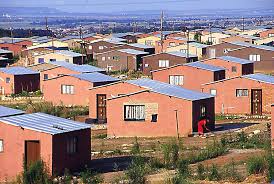
  Wentworth, the neighborhood where we live in Durban, is similar to Compton, but it is not home to the poorest of the poor.  It is considered a “bad” or unsafe neighborhood, but people here live in small, run-down houses or flats with electricity, running water and paved roads.  A level below where we live are ‘townships’--expansive, maze-like areas with narrow, bumpy roads, full of small, poorly built, single-room government-subsidized housing.  Sometimes half a dozen or more people can live in a little house that is less than 500 sq feet.


(Taken from ncccusa.org)

  A step down from the townships are the shantytowns, which are comprised of crooked, make-shift shacks, less than 200 sq feet, built of scrap metal, cloth and wood pieces nailed together.  These homes are erected by people from rural areas or poorer African countries who come to the city looking for jobs and a better life.These homes do not have organized plumbing or electricity.  They are built pretty much right on top of each other, connected only by foot paths.  This becomes a danger and health hazard because it facilitates the easy spread of fires from the cook fires as well as tuberculosis from poor ventilation.


Poverty is never easy to see and its existence is never easy to explain.  Intertwined with the complex history and racial dynamics in this country, part of the poverty can be explained by the nearly 50% unemployment rate and 40% HIV/AIDS rate in some areas.  South Africa is a country that has made huge strides since its break from Apartheid over 15 years ago, but she still has a long way to go.  It is a country blessed with an abundance of natural resources and wealth and only time will tell where its leaders will take her.


South African Fact:
A popular South African fast food is the bunny chow, aka bunny, created by the Indian community in Durban. It consists of a hollowed out loaf of bread filled with curry that people eat with their fingers.


(Taken from laraferroni.com)

Sunday, November 13, 2011

Safe in South Africa

Dubai, UAE    
    
Burj Khalifa in Dubai.
The tallest building in the world since 2010.
 On our way to South Africa, we spent a day and night in Dubai, which is probably one of the easiest airports to travel through.  It took us less than 10 minutes to step off the plane, get a free visa, and exit the airport.  Dubai is an interesting place with surprising contrasts: the extremes of conservatism (Muslim women covered in all black except for their eyes) alongside monuments to materialism (the Dubai mall, a 4 story monster with over 1200 stores, like Gucci and Louis Vuitton, 300 restaurants, an indoor waterfall, and the largest outdoor water fountain show in the world – all open until midnight). 

Wentworth in Durban, South Africa
     Upon arrival, I did not think Wentworth was that bad at all compared to other places that I have been to or how I imagined it to be.  However, after we were taken to some of the nicer areas in Durban, the contrast was obvious.  Where we live would be like Compton and some other places like Newport Beach. 
     Everyone tells us that it is safe here, but they also all have personal stories of attacks and robberies.  One man had 7 cars stolen! 
     The surroundings are beautiful and lush.  Although it is a big urban city, there is still a lot of nature, trees and animals.  I would compare Durban more to a city in Maui rather than Los Angeles.

What’s your living situation?
     
We live on a hill and we can see the Indian Ocean from the hospital compound, which is spread over at least 1 square mile.  We live about 1 mile from the nearest beach, but people say it is too dangerous to walk there. 
      Our small brick house ("the Matron's Cottage") has 2 bedrooms and 1 bathroom.  It was built during WWII when the hospital served as a British military hospital.  We pay a little over $100 US/month (it looks like it is worth about that). We have a grassy yard that surrounds the house and the monkeys like to play on our trees and roof, or even come into our house. We have also been trying to make friends with the kittens in our yard.
      In the kitchen we have a microwave, mini fridge and hot plate.  The electricity and water have been reliable.  We each have a little flimsy cot in our room, which is not working too well for Akbar.  Our bathroom situation is quite sad.  We have a toilet room and a shower room, but both rooms have major leakage problems.  Water comes up from the ground if we flush the toilet or use the shower so it smells like a 3rd world urinal with mildew….GEEEEE ROSS. The huge blessing/miracle is that the hospital sent over a maintenance man and contractor and they are completely gutting our bathrooms over the next few weeks.

What’s the weather like?
     We are now in the beginning of summer; it stays warm until May.  The days have ranged from 60F to 85F. Like at home, the days are warmer and nights cooler, requiring a jacket. It is not humid, but less dry than California.  It is sunny most days with a light rain in the late afternoon which is normal in the summer.

How’s work?
     Unfortunately, we have not been able to start work yet. Yes, we have been in this frustrating process for almost a year now.  Since it is a teaching hospital, we have been going to lectures daily and learning more about HIV and TB. About 60-80% of the patients admitted have HIV and/or TB.  We are at the last step with the S. African Health Professionals Council, which can take several weeks.  We definitely need prayer for God’s perfect timing because once December hits, the country goes to a stand still for a 1.5 month summer break.

South African Fact:
Indians have been living in South Africa for about 150 years. They were first brought in by the British for labor.